Running a small business is exciting, but it also comes with challenges.
Business owners often manage multiple responsibilities at the same time. They handle marketing, customer support, sales, accounting, content creation, and daily operations. Managing everything alone can be overwhelming.
This is where artificial intelligence can make a significant difference.
AI tools are helping small business owners save time, reduce costs, improve productivity, and make better decisions. Tasks that once required hours can now be completed in minutes with the help of AI.
The best part is that many AI tools are affordable and easy to use. You do not need advanced technical skills to benefit from them.
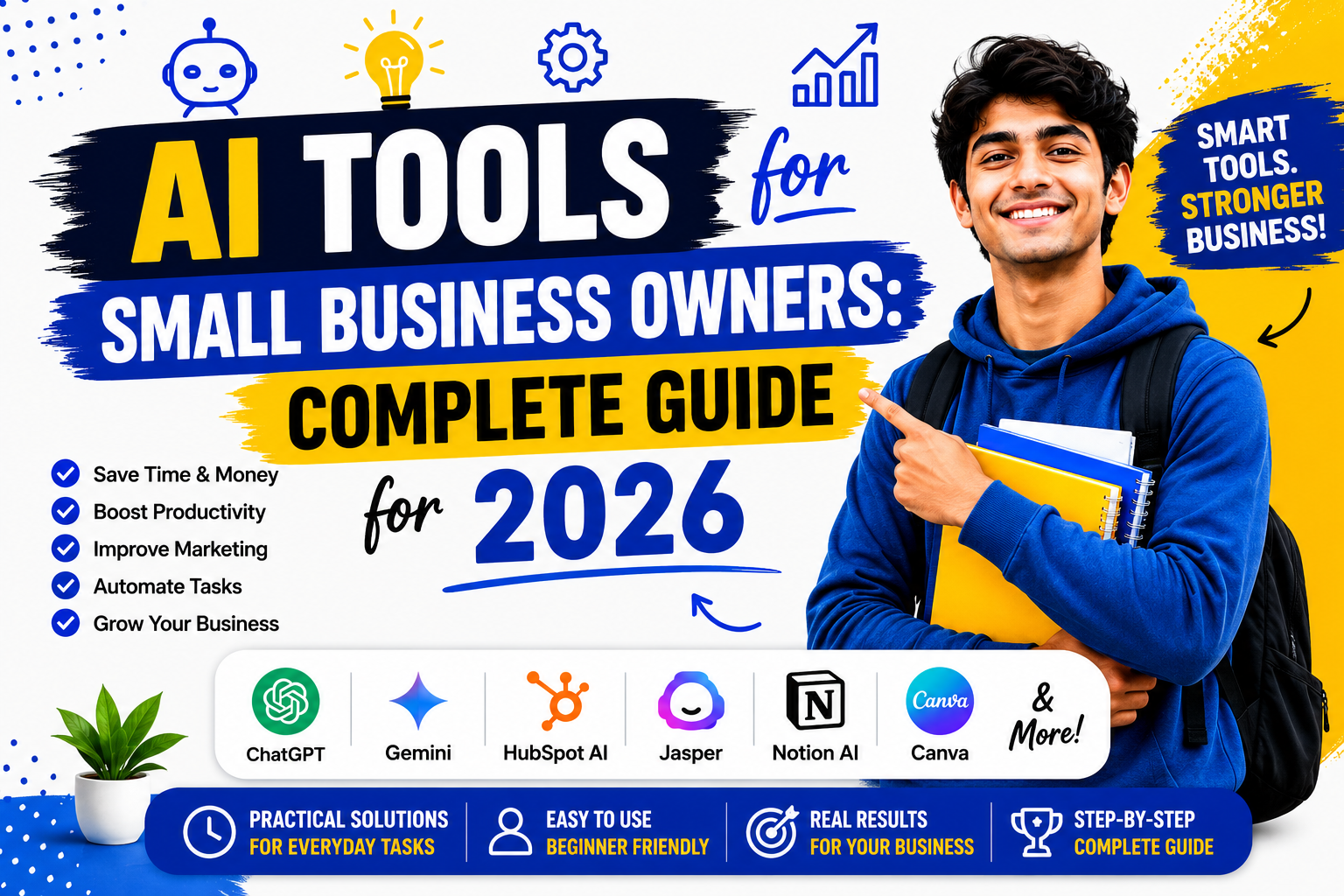
In this complete guide, you will learn what AI tools are, how they help businesses, and which AI tools are worth using in 2026.
What Are AI Tools for Small Business Owners?
AI tools are software applications that use artificial intelligence to automate tasks, analyze information, and improve efficiency.
These tools can help business owners with:
- Marketing
- Customer support
- Content creation
- Sales
- Data analysis
- Email management
- Social media management
- Business planning
Instead of spending valuable time on repetitive tasks, business owners can focus on growth and strategy.
Why Small Businesses Are Adopting A
Large companies have used advanced technology for years.
Today, AI allows small businesses to access similar capabilities without large budgets.
Save Time
Many business tasks are repetitive.
AI can automate routine work and free up time for more important activities.
Reduce Costs
Hiring additional employees is expensive.
AI tools can handle certain tasks at a fraction of the cost.
Improve Productivity
Business owners can complete more work in less time.
Better Customer Experience
AI helps businesses respond to customers faster and more effectively.
Smarter Decision Making
Many AI tools provide valuable insights that help business owners make informed decisions.
Benefits of AI for Small Businesses
Before exploring specific tools, let’s understand the biggest advantages.
Increased Efficiency
AI automates repetitive tasks and improves workflow.
Improved Marketing
AI can help create content, manage campaigns, and analyze performance.
Better Communication
Businesses can respond faster to customer inquiries.
Enhanced Data Analysis
AI can identify trends and opportunities that may otherwise go unnoticed.
Scalability
AI allows businesses to grow without increasing workload at the same pace.
Best AI Tools for Small Business Owners in 2026
Many AI tools are available today.
However, some provide significantly more value for small businesses.
Let’s examine the most useful options.
ChatGPT
ChatGPT is one of the most versatile AI tools available.
Small business owners use it for:
- Writing content
- Creating marketing copy
- Drafting emails
- Brainstorming ideas
- Customer communication
Advantages
- Easy to use
- Saves time
- Supports multiple business functions
- Helpful for content creation
Best Use Case
Content marketing and business communication.
Gemini
Gemini is Google’s AI assistant.
It is particularly useful for research and productivity.
Advantages
- Strong information retrieval
- Google ecosystem integration
- Helpful for business research
Best Use Case
Research and information gathering.
Claude
Claude is known for producing detailed and natural writing.
Many businesses use it for:
- Reports
- Long-form content
- Business planning
- Professional communication
Advantages
- Excellent writing quality
- Strong reasoning
- Detailed responses
Best Use Case
Professional content and business documentation.
Canva AI
Visual content is essential for modern marketing.
Canva AI helps businesses create:
- Social media graphics
- Marketing materials
- Presentations
- Promotional designs
Advantages
- User-friendly
- Fast design creation
- Large template library
Best Use Case
Marketing design and branding.
Grammarly
Professional communication matters.
Grammarly helps businesses improve:
- Emails
- Blog posts
- Website content
- Marketing materials
Advantages
- Better grammar
- Improved readability
- Professional communication
Best Use Case
Content editing and proofreading.
Notion AI
Organization is critical for business success.
Notion AI helps teams manage:
- Projects
- Tasks
- Documentation
- Meeting notes
Advantages
- Better organization
- Improved collaboration
- Productivity enhancement
Best Use Case
Business management and team collaboration.
HubSpot AI
HubSpot includes AI-powered marketing and sales tools.
Business owners can use it for:
- Lead management
- Customer relationship management
- Marketing automation
- Sales support
Advantages
- Strong CRM features
- Marketing automation
- Sales insights
Best Use Case
Customer relationship management.
Jasper AI
Jasper AI focuses on content creation and marketing.
Businesses use it to create:
- Blog posts
- Product descriptions
- Social media content
- Advertising copy
Advantages
- Fast content creation
- Marketing-focused features
- SEO-friendly output
Best Use Case
Content marketing.
How AI Helps Small Business Marketing
Marketing is one of the most important business activities.
AI can improve marketing performance in several ways.
Content Creation
AI can generate:
- Blog articles
- Social media posts
- Product descriptions
- Email newsletters
This helps businesses maintain a consistent online presence.
Social Media Management
AI tools can help schedule posts and generate content ideas.
Email Marketing
Businesses can create personalized email campaigns more efficiently.
SEO Optimization
AI assists with keyword research and content planning.
How AI Improves Customer Support
Customer service directly affects business success.
AI tools help businesses provide faster support.
AI Chatbots
Chatbots can answer common questions around the clock.
Faster Responses
Customers receive assistance without waiting for human agents.
Better Customer Satisfaction
Quick responses improve customer experiences.
Reduced Support Costs
Businesses can manage higher volumes of inquiries efficiently.
How AI Helps Increase Productivity
Time is one of the most valuable resources for small business owners.
AI helps eliminate repetitive tasks.
Examples include:
- Scheduling
- Data entry
- Content drafting
- Email management
- Meeting summaries
This allows business owners to focus on growth and strategy.
How AI Helps Increase Sales
Sales are the foundation of every business.
Without consistent sales, growth becomes difficult.
AI tools can help business owners improve their sales process and identify new opportunities.
Lead Generation
Finding potential customers takes time.
AI can help identify leads based on customer behavior and interests.
This allows businesses to focus on people who are more likely to buy.
Personalized Recommendations
Customers prefer personalized experiences.
AI can analyze customer preferences and suggest relevant products or services.
This often increases conversion rates.
Sales Forecasting
AI can analyze historical data and predict future trends.
This helps business owners plan inventory, marketing campaigns, and business growth strategies.
Follow-Up Automation
Many potential customers are lost because businesses fail to follow up.
AI tools can automate follow-up emails and reminders.
This improves customer engagement and increases sales opportunities.
How AI Helps with Financial Management
Financial management is one of the most important parts of running a business.
AI can simplify many financial tasks.
Expense Tracking
AI-powered software can automatically categorize business expenses.
This saves time and improves record-keeping.
Invoice Management
AI tools can create, send, and track invoices automatically.
This helps businesses maintain healthy cash flow.
Budget Planning
AI can analyze spending patterns and provide budgeting recommendations.
Financial Reporting
Business owners can generate reports quickly and gain valuable insights into business performance.
How AI Supports Business Analytics
Good decisions require accurate information.
AI helps businesses analyze large amounts of data quickly.
Customer Behavior Analysis
AI can identify:
- Customer preferences
- Buying habits
- Popular products
- Market trends
This information helps improve business strategies.
Performance Tracking
AI tools monitor important business metrics such as:
- Website traffic
- Sales performance
- Marketing results
- Customer engagement
Predictive Analytics
AI can help forecast future trends based on historical data.
This allows businesses to make proactive decisions.
AI Tools for Social Media Marketing
Social media is an important marketing channel for small businesses.
However, creating content consistently can be challenging.
AI helps simplify this process.
Content Creation
AI can generate:
- Captions
- Post ideas
- Marketing messages
- Content calendars
Scheduling Posts
Many AI-powered tools allow businesses to schedule content in advance.
Audience Analysis
AI can analyze audience engagement and suggest improvements.
Trend Monitoring
Businesses can identify trending topics more quickly.
Common Mistakes Small Business Owners Make with AI
AI can be extremely helpful.
However, many businesses fail to use it effectively.
Let’s examine common mistakes.
Expecting AI to Do Everything
AI is a tool.
It is not a complete replacement for human judgment.
Business owners should continue making important decisions themselves.
Ignoring Human Review
AI-generated content should always be reviewed before publishing.
This helps maintain quality and accuracy.
Using Too Many Tools
Some business owners sign up for numerous AI tools at once.
This often creates confusion.
Start with a few tools and expand gradually.
Neglecting Customer Relationships
AI can improve efficiency.
However, customers still value genuine human interaction.
Businesses should maintain a balance between automation and personal communication.
Not Defining Clear Goals
AI works best when there is a clear objective.
Business owners should identify specific problems they want AI to solve.
How to Start Using AI in Your Business
Many business owners feel overwhelmed by the number of available tools.
The best approach is to start small.
Step 1: Identify Time-Consuming Tasks
List repetitive tasks that consume significant time.
Examples include:
- Email responses
- Content creation
- Customer support
- Data entry
Step 2: Choose One AI Tool
Avoid adopting multiple tools at once.
Start with one solution that addresses your biggest challenge.
Step 3: Learn the Basics
Spend time understanding the tool’s features and capabilities.
Step 4: Measure Results
Track improvements in:
- Time savings
- Productivity
- Customer satisfaction
- Revenue growth
Step 5: Expand Gradually
Once comfortable, introduce additional AI tools where needed.
Real-World Examples of AI for Small Businesses
Understanding practical applications can make AI easier to implement.
Example 1: Local Retail Store
A local store uses AI to:
- Manage inventory
- Respond to customer inquiries
- Create social media content
The result is improved efficiency and better customer engagement.
Example 2: Freelance Consultant
A consultant uses AI for:
- Content creation
- Proposal writing
- Email management
This reduces administrative workload and increases productivity.
Example 3: Online Business
An eCommerce business uses AI to:
- Recommend products
- Analyze customer behavior
- Improve marketing campaigns
This helps increase conversions and sales.
The Future of AI for Small Businesses
Artificial intelligence continues to evolve rapidly.
Future developments may include:
- More advanced automation
- Better customer personalization
- Improved business forecasting
- Smarter analytics
- Stronger integrations
As AI technology becomes more accessible, small businesses will gain even greater advantages.
Businesses that adopt AI early may be better positioned to compete and grow.
Frequently Asked Questions (FAQs)
What are the best AI tools for small business owners?
Popular options include ChatGPT, Gemini, Claude, Canva AI, Grammarly, Notion AI, Jasper AI, and HubSpot AI.
Can AI help increase business revenue?
Yes.
AI can improve efficiency, customer engagement, marketing performance, and sales processes.
Is AI expensive for small businesses?
Many AI tools offer free plans or affordable pricing suitable for small businesses.
Do small businesses need technical skills to use AI?
No.
Most modern AI tools are designed for beginners and require minimal technical knowledge.
Can AI replace employees?
AI can automate certain tasks.
However, human creativity, leadership, and decision-making remain essential.
Is AI useful for customer support?
Yes.
AI chatbots and automation tools can improve response times and customer satisfaction.
Can AI help with marketing?
Absolutely.
AI assists with content creation, email marketing, social media management, and SEO.
Is AI safe for business use?
Most reputable AI platforms are safe when used responsibly and with proper data management practices.
Can AI help with business planning?
Yes.
AI can assist with research, forecasting, analysis, and strategic planning.
Should small businesses start using AI now?
Yes.
Early adoption can provide competitive advantages and improve operational efficiency.
Best Free AI Tools for Students in 2026
ChatGPT vs Gemini vs Claude: Complete Comparison
AI Tools for Small Business Owners
AI Tools for YouTube Creators
How to Use AI for Blogging: A Beginner’s Guide
AI Tools for Small Business Owners
About The Author