Artificial intelligence is changing how people learn, work, create content, and solve problems.
Tools like ChatGPT, Gemini, Claude, and other AI assistants can generate articles, answer questions, write code, create marketing plans, and even help with business decisions.
However, many people make one common mistake.
They assume AI automatically knows exactly what they want.
As a result, they receive generic, incomplete, or inaccurate answers.
The truth is simple.
The quality of the AI response depends heavily on the quality of the prompt.
A well-written prompt can transform an average response into something useful, detailed, and highly relevant.
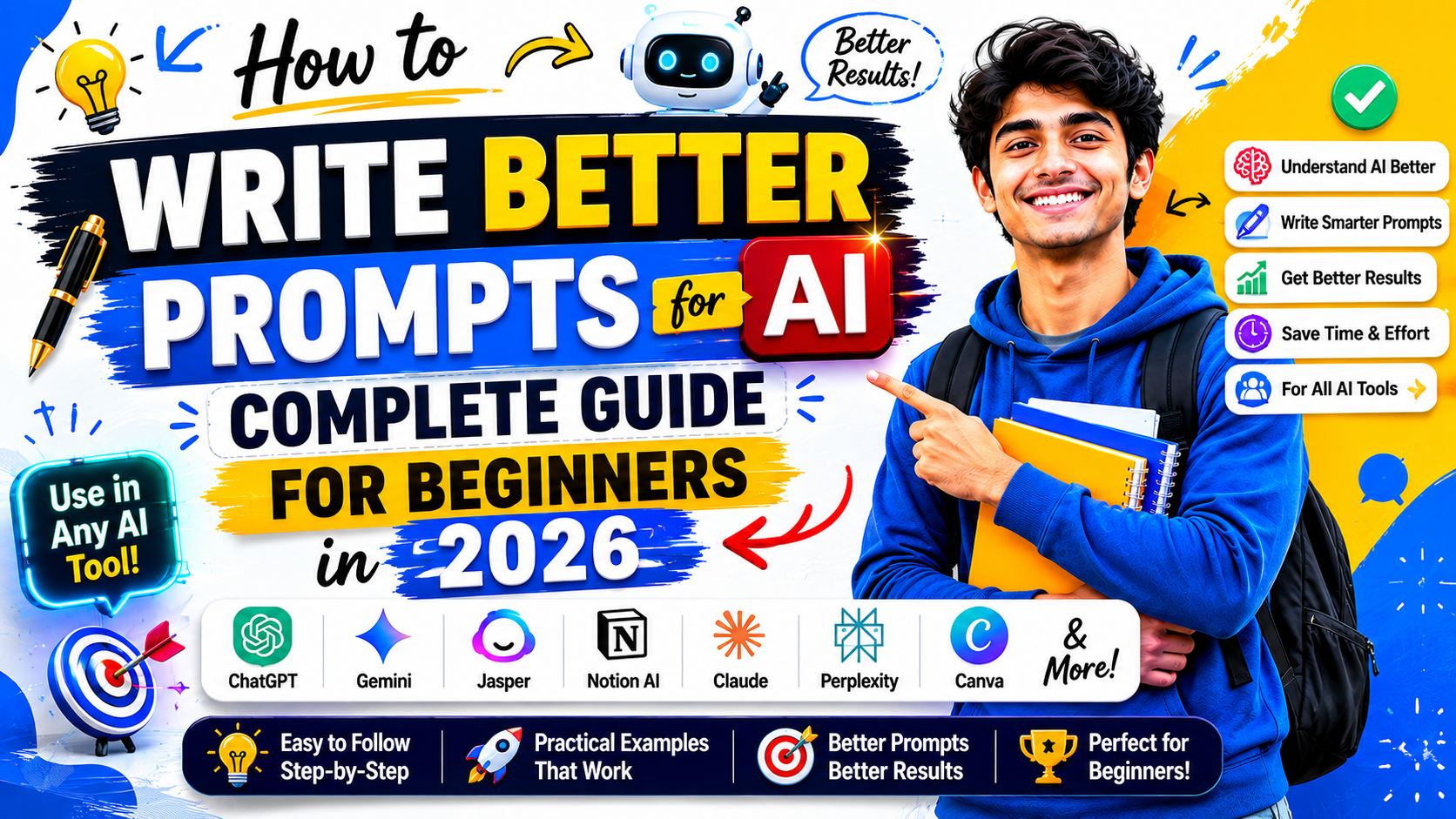
In this complete guide, you will learn how to write better prompts for AI, avoid common mistakes, and get better results from AI tools.
What Is a Prompt?
A prompt is the instruction, question, or request you give to an AI system.
Every conversation with AI starts with a prompt.
Examples include:
- Write a blog post about digital marketing.
- Explain artificial intelligence in simple words.
- Create a YouTube video script.
- Generate 10 business ideas.
- Summarize this article.
These are all prompts.
The AI uses your prompt to understand what you want and generate a response.
Why Prompt Writing Matters
Many beginners think AI is the problem when they get poor answers.
In reality, the problem is often the prompt.
Consider these examples.
Weak Prompt
Write about AI.
Better Prompt
Write a 2,000-word beginner-friendly article about AI tools for students. Include benefits, examples, FAQs, and a conclusion.
The second prompt provides clear instructions.
Because of that, the AI can generate a much better response.
Good prompts help you get:
- Better accuracy
- More detailed answers
- Faster results
- Improved productivity
- Higher-quality content
How AI Understands Prompts
AI does not read your mind.
It only understands the information you provide.
When you write a prompt, AI looks for clues such as:
- Topic
- Goal
- Audience
- Context
- Tone
- Format
- Length
The more useful information you provide, the easier it becomes for AI to generate relevant content.
Think of AI like a new employee.
If you give vague instructions, you get vague work.
If you give detailed instructions, you get better results.
Benefits of Learning Prompt Writing
Prompt writing is becoming one of the most valuable AI skills.
Let’s look at some advantages.
Better Responses
Clear prompts lead to more useful answers.
Time Savings
You spend less time rewriting instructions.
Improved Productivity
Tasks can be completed faster.
Better Content Creation
Writers and marketers can generate higher-quality content.
Better Learning
Students can receive clearer explanations and study materials.
Improved Business Results
Business owners can create better marketing plans, emails, and strategies.
The Simple Formula for Writing Better AI Prompts
Most successful prompts follow a simple structure.
Task + Context + Audience + Format + Tone + Requirements
Let’s break it down.
Task
Tell AI what you want.
Example:
Write a blog post.
Context
Provide background information.
Example:
The article is for beginner bloggers.
Audience
Explain who the content is for.
Example:
Target audience: Students and beginners.
Format
Specify the structure.
Example:
Use H2 headings, bullet points, and FAQs.
Tone
Describe the writing style.
Example:
Use a friendly and professional tone.
Requirements
Mention special instructions.
Example:
Keep paragraphs short and easy to read.
Prompt Formula Example
Here is a complete prompt using the formula.
Create a 2,500-word beginner-friendly article about AI tools for small business owners.
Target audience: New business owners.
Use H2 and H3 headings.
Include benefits, examples, FAQs, and a conclusion.
Use simple English and short paragraphs.
This prompt is much stronger than simply saying:
Write about AI tools.
Bad Prompt vs Good Prompt Examples
Understanding the difference between weak and strong prompts is essential.
| Bad Prompt | Better Prompt |
|---|---|
| Write about AI. | Write a beginner-friendly guide about AI tools for students. |
| Create a blog post. | Create a 2,000-word SEO article about blogging with AI. |
| Give business ideas. | Suggest 20 online business ideas for beginners with low investment. |
| Explain SEO. | Explain SEO to a beginner using simple language and examples. |
| Write a script. | Write a 10-minute YouTube script about AI tools for creators. |
The better prompt provides more context and direction.
The 7 Essential Elements of a Great Prompt
Most high-quality prompts contain these elements.
1. Clear Objective
Tell AI exactly what you need.
2. Context
Explain the situation.
3. Audience
Identify who will read or use the content.
4. Format
Specify structure requirements.
5. Tone
Define the writing style.
6. Length
Mention word count or approximate length.
7. Additional Instructions
Include special requirements.
Types of AI Prompts
Different tasks require different prompt styles.
Let’s examine the most common categories.
Content Writing Prompts
These prompts are useful for bloggers and writers.
Example
Write a 2,000-word article about AI tools for YouTube creators.
Include:
- Introduction
- Benefits
- Best tools
- FAQs
- Conclusion
Use simple English.
Educational Prompts
Students often use AI for learning.
Example
Explain photosynthesis to a 10th-grade student.
Use simple language and real-world examples.
Research Prompts
Researchers use AI to understand topics quickly.
Example
Provide a beginner-friendly summary of blockchain technology.
Include advantages and disadvantages.
Marketing Prompts
Businesses use AI to create marketing content.
Example
Create five Facebook ad copies for an online clothing store.
Use a persuasive tone.
Coding Prompts
Developers use AI for programming assistance.
Example
Write a Python program that calculates compound interest.
Explain each line of code.
Creative Prompts
Creative professionals use AI for brainstorming.
Example
Generate 20 unique YouTube channel name ideas for an AI tools website.
Why Specific Prompts Work Better
Specific prompts reduce confusion.
Compare these examples.
Weak Prompt
Write a social media post.
Better Prompt
Write a LinkedIn post for small business owners explaining how AI can improve productivity.
Use a professional tone and keep it under 200 words.
The second prompt is far more useful because it provides context and direction.
The Importance of Context
Context helps AI understand your situation.
Without context, AI must guess.
Without Context
Create a marketing plan.
With Context
Create a marketing plan for a new AI blog targeting students, bloggers, and content creators.
Context improves accuracy and relevance.
How to Define Your Audience
Audience information dramatically improves output quality.
Examples include:
- Students
- Teachers
- Business owners
- Bloggers
- Developers
- Freelancers
- YouTube creators
- Digital marketers
The more specific the audience, the better the AI response.
Advanced Prompt Engineering Techniques
Once you understand the basics of prompt writing, the next step is learning advanced prompting techniques.
These methods help you generate more accurate, detailed, and useful responses from AI.
Many professionals use these techniques daily to improve productivity and content quality.
Role Prompting
Role prompting is one of the most powerful prompt-writing techniques.
In this method, you tell AI who it should act as.
This helps the AI generate responses from a specific perspective.
Example
Instead of writing:
Write an SEO article.
Write:
Act as an experienced SEO expert and write an SEO-optimized article about AI tools for bloggers.
The second prompt usually produces a more professional result.
Popular Roles You Can Use
- SEO Expert
- Digital Marketer
- Teacher
- Business Consultant
- Software Developer
- Content Writer
- YouTube Strategist
- Social Media Manager
The right role often improves output quality significantly.
Chain Prompting
Many users ask AI to do everything in one prompt.
This often leads to average results.
A better approach is chain prompting.
Chain prompting means breaking a large task into smaller tasks.
Example
Prompt 1
Generate 20 blog ideas about AI tools.
Prompt 2
Create an outline for idea number 5.
Prompt 3
Write the introduction.
Prompt 4
Write the main content.
Prompt 5
Create FAQs.
This approach produces more detailed and organized content.
Step-by-Step Prompting
AI performs better when tasks are divided into steps.
Weak Prompt
Create a complete marketing strategy.
Better Prompt
Create a marketing strategy step by step.
First identify the target audience.
Then suggest marketing channels.
Then create a content plan.
Finally provide growth recommendations.
This structure helps AI stay focused.
Iterative Prompting
Prompt writing is often a conversation.
You do not need perfect results from the first prompt.
Instead, improve the output gradually.
Example
Initial Prompt:
Write a blog introduction about AI tools.
Follow-Up Prompt:
Make the introduction more engaging.
Second Follow-Up Prompt:
Add a statistic and a stronger opening sentence.
Each improvement makes the content better.
How to Control AI Writing Style
AI can write in many different styles.
You simply need to specify the desired tone.
Professional Tone
Write in a professional business style.
Friendly Tone
Write in a friendly and conversational tone.
Educational Tone
Write as if teaching a complete beginner.
Persuasive Tone
Write in a persuasive marketing style.
Formal Tone
Use formal language suitable for a business report.
The more specific your style instructions, the better the output.
How to Specify Output Format
Many users forget to tell AI how to organize the response.
This is a common mistake.
Always specify the format.
Blog Format Example
Write a blog post with:
- Introduction
- H2 Headings
- H3 Subheadings
- FAQs
- Conclusion
Table Format Example
Compare ChatGPT, Gemini, and Claude in a table.
Include:
- Features
- Pricing
- Pros
- Cons
List Format Example
List the top 20 AI tools for students using bullet points.
Prompt Templates for Bloggers
Bloggers can save significant time using reusable templates.
SEO Blog Template
Act as an experienced SEO content writer.
Write a 2,500-word article about [TOPIC].
Target audience: Beginners.
Include:
- SEO title
- Meta description
- Introduction
- H2 headings
- H3 headings
- FAQs
- Conclusion
Use simple English and short paragraphs.
Content Idea Template
Generate 50 blog post ideas about [TOPIC].
Group ideas into beginner, intermediate, and advanced categories.
Prompt Templates for Students
Students can use AI for learning and exam preparation.
Learning Template
Explain [TOPIC] in simple language suitable for a beginner.
Include examples and step-by-step explanations.
Exam Preparation Template
Create revision notes for [TOPIC].
Include:
- Important concepts
- Key definitions
- Practice questions
- Summary notes
Homework Assistance Template
Help me solve this problem.
Explain each step clearly.
Show your reasoning process.
Prompt Templates for Small Business Owners
AI can help business owners save time and improve efficiency.
Marketing Strategy Template
Act as a digital marketing consultant.
Create a marketing strategy for a small business selling [PRODUCT].
Include:
- Target audience
- Marketing channels
- Budget suggestions
- Growth opportunities
Social Media Template
Create 30 social media post ideas for a business in the [INDUSTRY] niche.
Business Growth Template
Suggest five growth strategies for a small business with limited marketing budget.
Prompt Templates for YouTube Creators
YouTube creators can use AI for planning, scripting, and optimization.
Video Ideas Template
Generate 50 YouTube video ideas for a channel about [NICHE].
Script Writing Template
Write a 10-minute YouTube script about [TOPIC].
Include:
- Hook
- Introduction
- Main Content
- Conclusion
- Call to Action
Thumbnail Ideas Template
Suggest 20 thumbnail text ideas for a YouTube video about [TOPIC].
Prompt Templates for Freelancers
Freelancers can use AI to improve productivity.
Proposal Template
Act as a freelance consultant.
Create a project proposal for a client who needs [SERVICE].
Client Communication Template
Write a professional email responding to a client inquiry.
Keep the tone friendly and professional.
Prompt Templates for Teachers
Teachers can use AI to create educational materials.
Lesson Plan Template
Create a lesson plan for [SUBJECT].
Include:
- Learning objectives
- Activities
- Homework
- Assessment questions
Quiz Generator Template
Create a 20-question quiz on [TOPIC].
Include answers.
Ready-to-Use AI Prompt Library
Here are some practical prompts that can be used immediately.
Content Creation
Generate 100 blog post ideas about [TOPIC].
SEO
Create an SEO content outline targeting the keyword [KEYWORD].
Social Media
Generate 30 LinkedIn post ideas about [TOPIC].
Email Marketing
Write a 5-email welcome sequence for new subscribers.
Business
Suggest ways to increase sales for a small online business.
Learning
Explain [TOPIC] as if teaching a 12-year-old student.
YouTube
Generate 50 YouTube Shorts ideas about [TOPIC].
Productivity
Create a weekly productivity plan for a remote worker.
Research
Provide a beginner-friendly summary of [TOPIC].
Marketing
Create a content calendar for the next 30 days.
Common Prompt Writing Mistakes
Many users fail to get good results because of simple mistakes.
Being Too Vague
Weak Prompt:
Write about AI.
Strong Prompt:
Write a beginner-friendly article about AI tools for students.
Not Providing Context
AI performs better when it understands the situation.
Always provide background information.
Ignoring Audience Information
Different audiences require different explanations.
Always define the target audience.
Forgetting Format Instructions
Tell AI how the response should be organized.
Asking Too Many Things at Once
Large tasks should be broken into smaller prompts.
AI Prompt Writing Checklist
Before sending a prompt, ask yourself:
✅ I clearly define the task.
✅ I provide enough context.
✅ Did I specify the audience?
✅ Define the format.
✅ Mention the tone.
✅ specify the desired length.
✅ Did I include any special instructions?
If the answer is yes, your prompt is likely to perform much better.
Pros and Cons of Prompt Engineering
Pros
- Better AI responses
- Higher productivity
- More accurate information
- Improved content quality
- Faster workflow
Cons
- Requires practice
- Complex tasks may need multiple prompts
- Poor prompts still produce poor results
- Some experimentation is necessary
Why Prompt Engineering Is Becoming an Important Skill
Artificial intelligence is becoming part of everyday work.
People who know how to communicate effectively with AI often gain better results.
Prompt engineering is now useful for:
- Students
- Bloggers
- Business owners
- Marketers
- Developers
- Content creators
- Educators
As AI adoption grows, prompt-writing skills will become even more valuable.
Frequently Asked Questions (FAQs)
What is a prompt in AI?
A prompt is an instruction or question given to an AI system.
Why are prompts important?
Prompts help AI understand exactly what you want.
Can better prompts improve AI responses?
Yes. Better prompts often lead to more accurate and useful answers.
What is prompt engineering?
Prompt engineering is the process of designing prompts that generate better AI outputs.
Is prompt engineering difficult?
No. Anyone can learn it with practice.
Which AI tools use prompts?
ChatGPT, Gemini, Claude, Copilot, and most AI assistants use prompts.
What is role prompting?
Role prompting means asking AI to act as a specific expert or professional.
Can prompt engineering improve SEO content?
Yes. Better prompts can help generate more structured and relevant SEO content.
Should prompts be long or short?
Simple tasks may need short prompts. Complex tasks usually benefit from detailed prompts.
Is prompt engineering a future-proof skill?
Yes. As AI becomes more common, prompt-writing skills are becoming increasingly valuable.
Best Free AI Tools for Students in 2026
ChatGPT vs Gemini vs Claude: Complete Comparison
AI Tools for Small Business Owners
AI Tools for YouTube Creators
How to Use AI for Blogging: A Beginner’s Guide
AI Tools for Small Business Owners
AI Tools for YouTube Creators: Complete Guide
How to Write Better Prompts for AI: Complete Guide for Beginners in 2026
About The Author