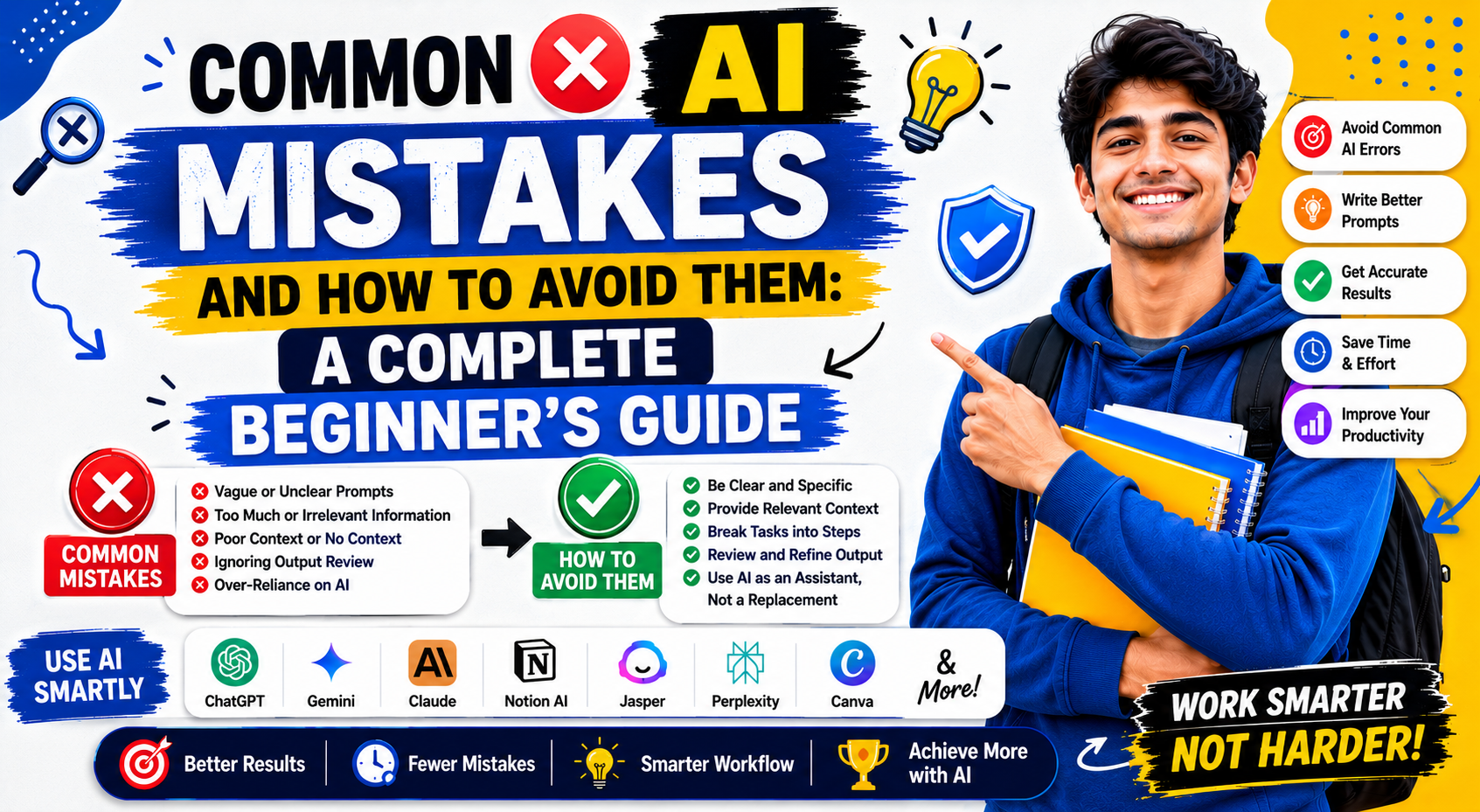
AI Mistakes :- Artificial Intelligence has become a part of everyday life. Students use it for learning. Bloggers use it for content creation. Businesses use it for productivity. Professionals use it to complete tasks faster.
However, many people assume that AI always provides accurate results. This belief often leads to poor decisions, low-quality work, and wasted time.
The truth is simple. AI is powerful, but it is not perfect.
Many users make avoidable mistakes when using AI tools. Some trust AI too much. Others provide poor instructions. Many people publish AI-generated content without reviewing it.
Understanding these AI mistakes can help you use AI more effectively. It can also improve the quality of your work and save valuable time.
In this guide, you will learn the most common AI mistakes, why they happen, and how to avoid them.
Why Understanding AI Mistakes Is Important
Many people focus on what AI can do.
Very few people focus on what AI cannot do.
This creates unrealistic expectations.
When users understand common AI mistakes, they can:
- Get better results
- Improve productivity
- Reduce errors
- Create higher-quality content
- Make better decisions
- Use AI more responsibly
Therefore, learning about AI mistakes is just as important as learning about AI tools.
Mistake #1: Trusting AI Without Verification
This is one of the biggest AI mistakes people make.
Many users assume AI always provides correct information.
Unfortunately, AI can sometimes generate inaccurate or outdated answers.
For example, an AI tool may provide:
- Incorrect statistics
- Outdated facts
- Wrong references
- Misleading explanations
How to Avoid This Mistake
Always verify important information.
Check facts from trusted sources.
Review data before publishing it.
Most importantly, never assume AI is automatically correct.
AI should assist your research, not replace it.
Mistake #2: Writing Poor Prompts
AI performance depends heavily on the instructions it receives.
Many users ask vague questions.
As a result, they receive vague answers.
For example:
Bad Prompt:
“Write an article about AI.”
Better Prompt:
“Write a beginner-friendly article about AI productivity for small business owners. Use simple language and practical examples.”
The second prompt gives AI much more context.
Therefore, the output becomes more useful.
How to Avoid This Mistake
Be specific.
Include:
- Purpose
- Audience
- Tone
- Format
- Length
- Goals
Clear instructions usually produce better results.
Mistake #3: Publishing AI Content Without Editing
Many website owners generate content and publish it immediately.
This approach creates several problems.
AI-generated text often contains:
- Repetition
- Generic statements
- Weak examples
- Robotic phrasing
Readers can quickly notice these issues.
Search engines also prefer content that provides genuine value.
How to Avoid This Mistake
Always edit AI-generated content.
Add:
- Personal insights
- Real examples
- Expert opinions
- Practical tips
Human editing improves content quality significantly.
Mistake #4: Ignoring Context
AI works best when it understands the full context.
Many users provide only a small amount of information.
As a result, AI fills gaps with assumptions.
This can lead to inaccurate responses.
How to Avoid This Mistake
Provide complete information.
Explain:
- The goal
- The audience
- The background
- The expected outcome
More context usually produces better results.
Mistake #5: Depending on AI for Every Task
AI is an assistant.
It is not a replacement for human thinking.
Some users try to use AI for every decision.
This often reduces critical thinking skills.
How to Avoid This Mistake
Use AI as a support tool.
Continue using:
- Human judgment
- Experience
- Creativity
- Industry knowledge
The best results usually come from combining human expertise with AI assistance.
Mistake #6: Using AI for Sensitive Information
Many users share confidential data with AI tools.
This can create privacy risks.
Examples include:
- Financial records
- Customer information
- Personal details
- Business secrets
Not every AI platform handles data in the same way.
How to Avoid This Mistake
Review privacy policies carefully.
Avoid sharing confidential information unless absolutely necessary.
Protect sensitive data at all times.
Mistake #7: Expecting Perfect Results
Many beginners expect AI to deliver perfect answers immediately.
When this does not happen, they become frustrated.
The reality is different.
AI often requires:
- Better prompts
- Additional instructions
- Multiple revisions
How to Avoid This Mistake
Treat AI as a collaborative tool.
Refine prompts.
Ask follow-up questions.
Improve responses through conversation.
Better results usually come from iteration.
Mistake #8: Using Outdated AI Tools
The AI industry changes rapidly.
New features appear frequently.
Some users continue using outdated tools even when better options exist.
This can limit productivity.
How to Avoid This Mistake
Stay updated with AI developments.
Explore new tools regularly.
Compare available options.
Choose tools that match your current needs.
Mistake #9: Ignoring AI Limitations
Every AI system has limitations.
Some struggle with:
- Complex reasoning
- Real-time information
- Specialized expertise
- Emotional understanding
Ignoring these limitations can create problems.
How to Avoid This Mistake
Understand what AI can and cannot do.
Use AI for suitable tasks.
For important decisions, seek professional advice when necessary.
Mistake #10: Failing to Learn Prompt Engineering
Prompt engineering is becoming an important skill.
Many users underestimate its value.
They ask basic questions and expect advanced results.
How to Avoid This Mistake
Learn how prompts work.
Experiment with:
- Detailed instructions
- Step-by-step requests
- Role-based prompts
- Examples
Strong prompting skills often produce significantly better outcomes.
Mistake #11: Creating Low-Quality SEO Content
Many website owners use AI to generate dozens of articles quickly.
However, quantity does not guarantee success.
Low-quality content often lacks:
- Depth
- Originality
- User value
- Expertise
This can hurt website performance.
How to Avoid This Mistake
Focus on quality first.
Create content that:
- Solves problems
- Answers questions
- Provides examples
- Delivers unique insights
High-quality content performs better over time.
Mistake #12: Forgetting the Human Experience
Content is created for people.
Many AI-generated articles sound robotic.
Readers prefer content that feels natural.
They want practical advice and real experiences.
How to Avoid This Mistake
Write for humans first.
Use:
- Simple language
- Short paragraphs
- Practical examples
- Conversational tone
This improves both user engagement and readability.
Signs You Are Making AI Mistakes
You may be making AI mistakes if:
- Results often feel inaccurate
- Content sounds repetitive
- Readers lose interest quickly
- AI responses require major corrections
- Productivity is not improving
Recognizing these signs early can help you adjust your approach.
Best Practices for Using AI Effectively
To avoid common AI mistakes, follow these best practices:
Use Clear Instructions
Specific prompts usually produce better responses.
Verify Important Information
Always fact-check critical details.
Edit Every Output
Never publish content without review.
Combine Human Knowledge with AI
Use AI to support expertise, not replace it.
Stay Updated
AI tools evolve quickly.
Learning new features can improve productivity.
Frequently Asked Questions
What are the most common AI mistakes?
The most common AI mistakes include trusting AI blindly, writing poor prompts, publishing content without editing, and ignoring AI limitations.
Why do people make AI mistakes?
Most people make AI mistakes because they expect perfect results and do not fully understand how AI systems work.
Can AI generate incorrect information?
Yes. AI can sometimes provide inaccurate, outdated, or misleading information. Therefore, fact-checking is important.
How can beginners avoid AI mistakes?
Beginners should use clear prompts, verify information, edit AI outputs, and learn the strengths and limitations of AI tools.
Are AI mistakes harmful for SEO?
Yes. Poor-quality AI content can reduce user engagement and negatively affect search performance.
Note
AI can be an incredibly useful tool when used correctly. It can improve productivity, save time, and simplify many daily tasks. However, users must understand common AI mistakes before relying on AI for important work.
Trusting AI without verification, using poor prompts, ignoring context, and publishing unedited content are some of the biggest mistakes people make today.
Fortunately, these problems are easy to avoid. By using clear instructions, reviewing outputs carefully, and combining AI assistance with human expertise, you can achieve much better results.
The goal is not to let AI do all the work. The goal is to use AI wisely. When you understand its strengths and limitations, AI becomes a powerful partner that helps you work smarter, create better content, and make more informed decisions.
Best Free AI Tools for Students in 2026
ChatGPT vs Gemini vs Claude: Complete Comparison
AI Tools for Small Business Owners
AI Tools for YouTube Creators
How to Use AI for Blogging: A Beginner’s Guide
AI Tools for Small Business Owners
AI Tools for YouTube Creators: Complete Guide
How to Write Better Prompts for AI: Complete Guide for Beginners in 2026
How AI Can Save Time in Daily Work: A Complete Guide
Common AI Mistakes and How to Avoid Them
About The Author